The key to success in any investigation, in my opinion, is to be right, to be correct with your analysis of the facts and testimonies collected. You have to be correct and logical with your conclusions and you have to make recommendations, recommended corrective actions based solely on the conclusions. I would say that somewhere between 90-95% of the time that accident boards get the form of the investigation incorrect. They list conclusions without logically supported analysis, they come up with recommendations out of the clear blue sky with no support from the conclusions and they do not even collect all of the facts.
Case in point?
Take BEA’s investigation of AF447. I have not read a single fact, analysis or conclusion so far that leads me to believe that BEA considered the role of AF Dispatch Office in the mishap. It was AF Dispatch Office that had all of the latest and current metro satellite data that showed massive thunderstorms in the flight path of AF447, rising to altitudes well above the Airbus operating ceiling. Even while AF Dispatch had this data, they took no action to warn AF447 even though it was their specific requirement to do so since AF is a scheduled airline and AF447 was a dispatched flight.
Send any current airliner into a 60,000+ foot thunderstorm at night and I doubt any will escape the encounter unscathed. Plus passenger injuries are likely to be sustained even if the airframe makes it out the other side. Plus few passengers will speak well of the flight experience if they manage to live through being inside a 60,000+ ft thunderstorm.
In my opinion, political pressure on an investigation is not really so much an issue as is the poorly handled investigation, collection of the facts, poor analysis, poor conclusions and poor tie in of recommendations. Political and party pressures are a fact of life. They are afraid, under stress, and will do anything to survive. But the truth can not be hidden. If it is not found, the board wasn’t looking hard enough.
Many of the blog readers have wondered, “How cost effective is a good safety program?” So, let’s look at some well known accidents to see first of all how much they cost? Comair at Lexington will run about $700 million when it is all done. Colgan Air at Buffalo will run about $500-650 million when it is all done. Air France in Toronto will run about $350 when it is all done. Air France off of Brazil in the Atlantic, costs will be dampened by the French legal system, but losses will exceed $350-400 million.
Well these are four familiar mishaps. Just on these four mishaps alone, the costs of the financial losses will exceed $2 billion. That is a huge sum of money and it will be paid out not to improve safety, but rather as damages for property and lives. After all of that money is spent, the safety issues involved in each mishap will also have to be addressed and fixed to prevent the next mishap from occurring again.
So, as far as the bottom line is concerned, accidents are a terrible business decision. To me, a much sounder business strategy would be a good safety program. And I have not heard of any safety program running into the $2 billion range yet!!
Quite the opposite usually, since most good safety programs really focus on human factors, people and as such really don’t cost that much. Safety works best when is listens to what people are telling it, through a well run reporting and hazard resolution system.
Having run many such programs, I can assure you that I never had a $2 billion safety budget, nor anything remotely approaching that.
So, to answer the question, I would say a good safety program is a whole heck of a lot cheaper than an aviation disaster, for sure!
This Microsoft Powerpoint presentation is a lot of fun to watch, but it also delivers the safety forecast message that all safety managers can and should create their own safety forecast and their own local safety plan based on that forecast.
In addition Miller’s formula for Safety Risk is provided. You will get to see how Safety Risk (Z) equals Probability (X) times Severity (Y) and have a look at a 3D plot of Z=XY. Other Miller Safety Rules, Theorems and Corollaries are presented.
Let me know what you think by posting a comment or emailing me: paulmiller@safetyforecast.com
Safety managers must be good listeners. It has been my experience that few if any reports from people participating in safety suggestions are actually “trivial.”
My experience is actually just the opposite. My experience is that everyone who came to my office to make a report had an important idea to share or an important here-to-fore unreported risk to which to bring our attention.
By listening to the person reporting and taking time to clarify their concern, our safety programs achieved two important goals. First, we found risks that only one person recognized. Funny how in an organization of 300 people, that only one person will see and be willing to report a very valid hazardous risk. Not sure why that is so, but it is. Second, by listening to all who came in to report, and publishing all reports and recognizing the best each week, we developed the excellent reputation of being the “good listener.” You would be amazed at the things that really need to be fixed that no one else noticed or bothered to tell anyone about.
So, my suggestion is do not worry about “triviality.” In fact the report may be of quite some significance when you later understand its true potential for prevention.
Again that is my experience and I would add, that by doing so, our safety program achieved the goal of reducing losses due to injuries and deaths, property damaged or destroyed to zero. So, I would say that this program worked very well in four very different organizations.
Can Safety Be Done by One Manager? I would add, that Safety is not a job that can be done by one. In fact at my pilot association we had 14
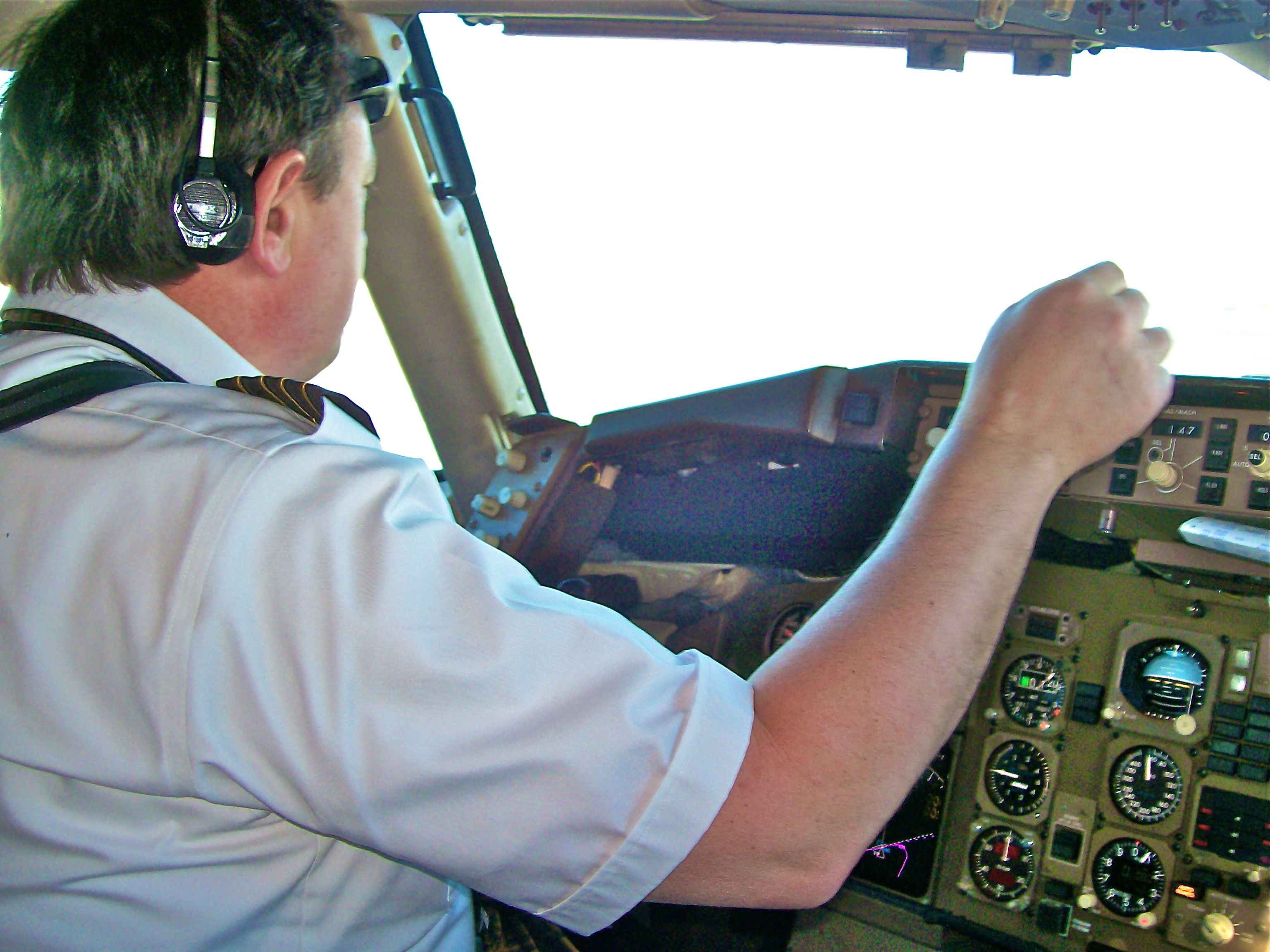
Alone in the sky with the sunrise.
committees that dealt with some portion of the safety pie, yes 14! And we were not the company, we were just the pilot group. Safety is not something that can be done from an asset poor point of view! Safety requires a great deal of attention.
What many airlines have found is that by failing to do the safety job of prevention well, that instead they wind up doing the mishap investigation job. And what a huge waste of time and money that is!!
There has never been a mishap investigation in which I participated, where in the end the conclusion that this mishap was preventable was not reached!
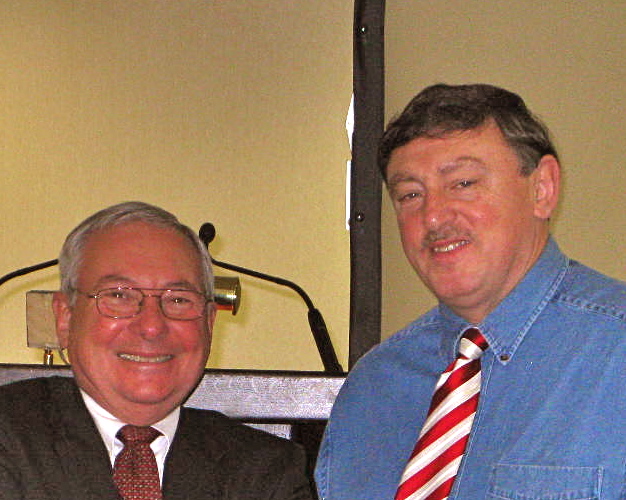
Captain David Williams and Captain Paul Miller at recent safety seminar.
So now you are probably asking, “Okay, how do I get 14 pilot association committees to work with me, the airline safety manager?”
I am so glad that you asked!!!
The key to success here is by working Jointly with the pilot association. What is that? Your airline does not have a pilot association? Hmmm, I wonder if the airline management has done everything possible to discourage a pilot union from forming? If so, they have really done the airline a great disservice. What is that? You say that this same airline management team has only provided the minimum of one person for the entire airline safety program? Wow! That same team has really done the airline a disservice!
In the case about which I previously spoke, our pilot union had 14 committees and well in excess of 100 people doing volunteer safety work on behalf of the union membership. But who also benefited?
Well of course the answer is that the company benefited greatly.
So, how many airlines have the model of a Joint Safety Program?
Not too many.
How many could have an exceptionally effective safety program at very little extra cost by working Jointly with the pilot group?
A person I knew stated, “We learn on how to prevent mishaps by deriving from the investigations stemming from mishaps.”
I agree that we learn by observing the mistakes that are made. That being said, I would add that we actually have a more superior ability to observe these mistakes as they are made on the line and before they contribute to a mishap.
Did you know for example that Safety Theory tells us that flight crew will make 1000 errors which could lead to 100 reportable events, which could lead to 10 incidents and which could lead to 1 major mishap.
Many people do not believe that or do not understand this very valuable nugget of safety information. This is the key to succeeding in the safety profession and I will tell you this from my own 43 years of experience. You can achieve zero mishaps, you can prevent mishaps at your airline.
Here is how to do it. You must have a reporting system that allows flight crew members to speak about and report their errors and those that they observe. Next the safety person has to investigate these errors, figure out how they impact the operation and take steps to correct the organic reason for the errors. Most often in my experience this involved some adjustment, modification or addition to SOP. But the safety person has to be well versed in flight ops and SOP so that the changes to SOP make sense.
Unfortunately all too many people believe that until an event, incident or mishap occurs, that their operation doesn’t “have a problem.” However the problems are there because we are human. They will always be there. The key is to incorporate the error reporting process into day to day operations, to talk about them and fix them right then and there.
Allowing human errors to “fester,” to unreported and uncorrected is to set the operation up to failure. Can an operation be made error free? Of course not. But at the same time can an operation be made mishap free? Absolutely so, by finding and fixing errors as they occur.
But I believe that as humans we are constantly making errors
It has been said, “You seem to be convinced that a flawed world can be actually made flawless.”
My response is this. Human error is part of our nature. However we can make our own flight operations mishap free by remembering Miller’s Rule for Safety Management: ALL SAFETY IS LOCAL.
Any one safety manager cannot make a “flawed world ….. flawless.” He or she can only affect the operation over which they have control.
I can personally recommend steps to each LOCAL Flight Operations Safety Manager that have worked extremely well to achieve mishap free flight operations.
One person commented, “In a process oriented investigation “human error” cannot be the ultimate root cause. You need to ask yourself, “Why did the humans make the errors?”
My response to this is, “True, but you also need to go further and ask what procedures can be put into the SOP and become part of the training program that will help flight crew members overcome their human errors.
For example, lets say that a very important system characteristic is buried on page 49 of a chapter in the Aircraft Operating Manual. Well, maybe if it is considered to be so important, should it be bold faced, underlined and not buried on page 49? In other words, humans make errors that can easily be corrected. Safety managers need to find ways to help the flight operation correct errors as they are occurring and are reported.
Some have also said, that crew selection and training criteria are often driven by both financial and safety level aspects. FAA and other civilian authorities have criteria set at minimal requirements. But one company may decide to exceed those.
For example, one company may decide to select pilots (1) which have a Commercial Pilots License from a school with a weak syllabus and accept those after a minimal medical and psychological selection process, accepting captains with only 3,000 flight hours. Another company may have require at least a masters degree in technical sciences and demand a very strict medical and psychological selection criteria and accept captains only after 30,000 hrs. The same could and often does apply to training. One set of training requirements are used for a Government operation and another set of training criteria are used for a major airline.”
But my response is this. You still have to train flight crew in the company SOP. You still have to check to the SOP and make your operation “procedure oriented” and not technique oriented. This way flight crew are performing procedures and not using their own techniques to operate.
Further, as the operation improves its control, it will develop a need to have more standardization in procedures just so that mixed crews can operate efficiently.
Should the FAA tolerate such a wide variance between airlines? It is the Topic for another day.
Does not the person in charge of any vessel or organization bear some legal responsibility? If so, why would anyone be surprised to see a pilot jailed following an accident? Are we really just seeing the terribly weak legal profession just beginning to realize how much work has gone undone in the past 70 years.
If in an accident, lives are lost and property is destroyed, why wouldn’t victims, survivors and claimants seek some form of compensation?
Is it really the accident investigation profession which has been dropping the ball all these years? Has ICAO really taken all the action that it could to actually promote safety and promote learning from investigations?
Or has the case really been made year after year that it is the pilots who made the errors and that is all the blame that we need to know about?
So finally everyone is reading these atrociously poorly prepared and written accident reports and noting what was written so often.
For years airlines, the FAA and NTSB has been laying all blame on pilots, often those deceased in the mishap, and directing attention away from ATC, manufacturers, the weather guessers, airport operators, and everyone else. So here we are in 2011, surprised and complaining.
Yet even as we write this blog, the BEA has issued a scathing reproach of the AF447 pilots who could not decipher the cryptic puzzle presented before them, struggled to save their own lives for several minutes before perishing. Nowhere in the report is any mention made of the responsibility of the dispatch office to advise of foul weather, of the manufacturer to sell good equipment, of the airline to verify that the equipment works, of ICAO and other agencies to keep updating all technology for the benefit of the flight crew. A passenger sitting in row 24 on that airbus could have accessed the internet and obtained the most up to the minute satellite pix, but the flight crew had on board pix probably over 4 hours old.
How inaccurate a weather data process could anyone ever invent? Make a copy of the last satellite shot an hour before brief time, have it ready for the crew who show up an hour and a half before take off and give them one hour old data. By the time they take the runway, the data is 2 1/2 hours old. At three hours into the flight the data is 5 1/2 old.
But wait, isn’t the entire life cycle of convective weather defined as a matter of 30-45 minutes, may be an hour tops? Moreover, doesn’t convective weather around the tropics often build at 4000 to 6000 feet per minute?
So how could 4-5 hour old weather ever be considered accurate or useful data for safety purposes? Why wouldn’t the airline and their dispatch office know this? Why would the official weather forecasters not offer more accurate weather data, some form or method of updating that sat pix in flight to the flight crew?
Oh yes the passenger in 24E has the latest sat shot on his PC.
So I can easily see why ICAO and BEA and everyone else are so determined to blame the pilots and by that process, not give a second’s care about what might happen to passengers tomorrow who might be in similar jeopardy.
Do you not think that the same mishap cannot happen tomorrow? Think harder. It can and it most likely will.
Just Culture proposes the idea that when the injury and loss of people, the damage and destruction of property is the result of a commercial aviation mishap, that all charges of criminality be suspended so that a safety investigation of the mishap can be completed without interference. My suggestion is that the safety investigation and the investigations to determine who was at fault for the losses and who pays for the losses proceed simultaneously. Real evidence can be shared but evidence based on crew and other witness testimony should be determined solely by the board doing that investigation. Each board can and therefore should gather their own testimony evidence.
In the past, aircraft mishap boards have taken real evidence away from the public, which I do not believe is right. Additionally, they have taken years, 2-3 and more years to come out with any kind of useful reports, in essence failing to do the safety task of a quick safety hazard identification.
So now we find ourselves in a position where parties want recompense and no longer are willing to wait 8-10 years. No surprise that pilots are being jailed when an aviation mishap occurs where people are hurt and property is damaged. Just Culture is a good idea and I support it. But an even better idea is to prevent mishaps so that a flight never experiences a mishap and the lawyers are left with nothing to do.
Captain Miller with US Supreme Court Justice Sandra Day OConnor
I cite a flawed investigation as the cause for re-occurrence because in aviation you have one chance to get it right. You must gather the right facts, gather the right testimony, analyze the data, reach the correct conclusions and create recommendations for corrective actions. In the process you will find human error or human factors. This is where the mishap occurred. It was not the thunderstorm that caused the weather, it was the failure of the humans to avoid the thunderstorm that caused the mishaps, for example.
If you connect coincidental events together but then label them as “causation” you will fool all the people some of the time. An example is placing pilot error as the cause, when in reality when the pilot reported for work, was assigned the flight and climbed into the seat, he/she was “fully qualified” according to the FAA, the company and any other regulator. If that pilot made a pilot error as gross as stalling the aircraft on final and not recovering, the pilot, a product of the company and FAA training and qualification program to me, appears to be untrained and unqualified in this area. Since most would consider this area of flight procedures to be a skill critical to safe flight it would appear to me that the training and qualification program was deficient. Failing to correct the training and qualification program in my mind would be an example of a flawed investigation, wherein I would expect a same or similar mishap to occur at some time in the future at that airline, or to similarly trained and qualified airmen.
If you miss this opportunity to get the investigation right, then you can pretty much expect that the next pilot, similarly trained and qualified, facing similar circumstances to make the same mistakes. The purpose of the investigation is to find these flaws and recommend training to overcome this skill deficiency.
Look at how we all do windshear recovery training to proficiency now. Too bad the pilots at Kenner, Kennedy, DFW, Charlotte and other places did not have that training.
We are lucky that we had Dr. Fujita and the training that resulted from his models and those of NCAR in the 1980’s to inform us on how to react to inflight encounters with microbursts.

 A person I knew stated, “We learn on how to prevent mishaps by deriving from the investigations stemming from mishaps.”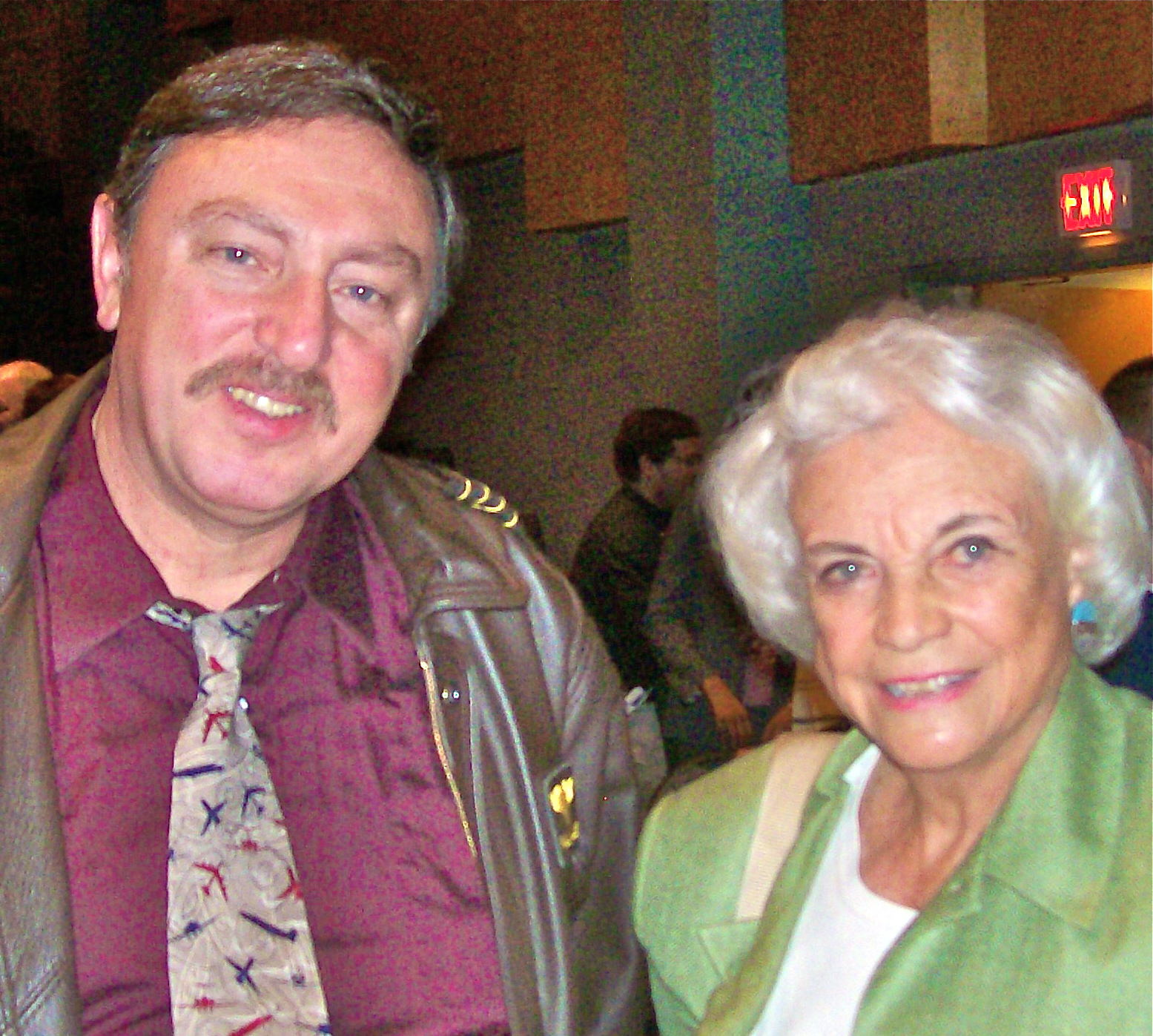
 Safety Forecast